
How To Install Sandisk U3 Launchpad Installer
I then drag and dropped the contents of my old USB drive into my new one. But then I thought, it would be cool to have my programs on the U3 Launchpad. I quickly realized the only way to add programs was adding programs from their list of supported programs [ http://software.u3.com/ ] or by adding a .u3p package. At first I thought the Launchpad was useless because the programs I wanted didn't have a u3p package, but I knew there had to be a way I could get my programs onto the Launchpad List.
Connect the USB drive to your computer. Install and launch AOMEI Partition Assistant. Right click the USB drive and select Rebuild MBR. Choose the proper MBR type for your operating system in this window. Click Apply and then Proceed to commit the operations. Insert the U3 flash drive to the PC’s USB port 2. Click the U3 icon on the system tray. Click Settings then select U3 Launchpad Settings 4. Insert the U3 flash drive to the PC's USB port 2. Click the U3 icon on the system tray. Click Settings then select U3 Launchpad Settings 4. Click Uninstall on the left panel, and then click on the Uninstall U3 Launchpad button on the right. Click Next to continue. You will be given an option to restore your files after removing U3. Note: This link takes you to the vendor's site, where you can download. The reinstallation of U3 Launchpad software and feature-set to U3 smart driver is manufacturer’s dependent process, where you need to download U3 LaunchPad Installer or Updater that will install or update the U3 Launchpad.
----
Beginner's Guide to Adding Programs
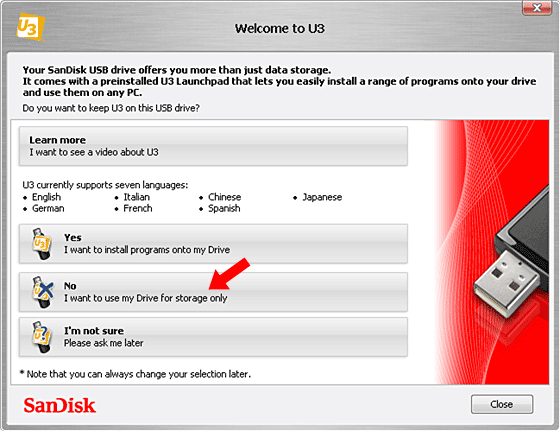
A U3 'smart drive' is a USB drive with a small partition that acts as a virtual CD-ROM drive. The virtual CD drive allows the USB drive to autoload the U3 Launchpad when you insert it into a computer. The Launchpad allows you to easily access your programs. For more information about the U3 smartdrive visit http://www.everythingusb.com/u3.html
This is a simple guide to adding a icon to your program list. I'm going to use PortableVLC for this example. [ PortableVLC ]
1. Install the portable Application anywhere on the USB drive.
(ex: G:program filesPortableVLC)
2. Open up the Hidden System folder in the root of the drive and navigate into the Apps folder. Create a folder of any name, the program name makes things easier. This is going to become the uuid, so remember what you named it for later.
(ex: i created G:SystemAppsvlc)
3. Inside the newly created folder, make a new folder named Manifest . Inside create a new notepad document. Rename the document to Manifest.u3i . Manifest.u3i is really a disguised XML file that the U3 Launcher uses to describe your program with. Having one is Vital to the Launcher.
(ex: i created G:SystemAppsvlcManifestManifest.u3i)
4. Make or find an icon. I normally either find the offical *.ico somewhere in the folder where its installed or just go to the website of whoever makes it and steal the favicon.ico (ex: for vlc i found the vlc icon in G:program filesPortableVLCPortableVLCCode but you can also find a lower quality one at http://videolan.org/favicon.ico ). Put the .ico in the Manifest folder right next to the Manifest.u3i
5. Edit Manifest.u3i in notepad (or TextPad, etc)
<?xml version='1.0' encoding='UTF-8'?>
<u3manifest version='1.0'>
<application uuid='vlc' version='0.8.4a'>
<icon>vlc.ico</icon>
<name>VLC</name>
<vendor url='http://portableapps.com/apps/audio_video/media_players/portable_vlc'>Portable VLC</vendor>
<description>VLC media player is a highly portable multimedia player for various audio and video formats (MPEG-1, MPEG-2, MPEG-4, DivX, XviD, WMV, mp3, ogg, ...) as well as DVDs, VCDs, and various streaming protocols. It can also be used as a server to stream in unicast or multicast in IPv4 or IPv6 on a high-bandwidth network.</description>
<options>
<minFreeSpace>16</minFreeSpace>
<upgrade appData='overwrite' deviceExec='overwrite'/>
</options>
</application>
<actions>
<appStart workingdir='%U3_DEVICE_PATH%program filesPortableVLC' cmd='%U3_DEVICE_PATH%program filesPortableVLCPortableVLC.exe'>start</appStart>
<appStop workingdir='%U3_DEVICE_PATH%program filesPortableVLC' cmd='%U3_DEVICE_PATH%program filesPortableVLCPortableVLC.exe'>stop</appStop>
</actions>
</u3manifest>
Make application uuid the same name as the file folder in your Apps directory (ex: vlc in my case). This is the ID of the application, you will need to use it again elsewhere. version is just the version of the application, its arbitrary, set it correctly if you want your launcher to display the correct ver #.
icon is the name of the icon that you want to display on your program list. ill go over this in the next step.
name = display name.
vendor url and description = the url of the program's website and the description displayed in 'Manage U3 Programs.'
minFreeSpace
What Is U3 Launchpad
= number of MB that the program requires on the drive, rounded up to the nearest MB.appStart and appStop , there are a few more optional actions like clean up, but these two are the required two to run your program. workingdir = the directory that your program runs from/in. Set this as the file folder that your executable is located in, make sure you use %U3_DEVICE_PATH% rather than the drive letter (ex: G:). cmd = the executable that you want to run when you click the button.
Save.
6. Zip the Manifest folder and name as the same name of your uuid from before. The items inside the zip file MUST be placed in the correct location.
Follow my example:
Inside my vlc.zip is a Folder with the name Manifest
Inside the Manifest folder is a Manifest.u3i and a vlc.ico
vlc.zip => ManifestManifest.u3i and Manifestvlc.ico
Now rename the uuid.zip folder to uuid.u3p (ex: vlc.zip -> vlc.u3p) and leave it in the uuid folder (ex: now i have a G:SystemAppsvlcvlc.u3p)
7. Go back to the Apps folder (ex: G:SystemApps) and find and edit the LPDB.xml file.
add in <APPLICATION guid='vlc' launchOnStart='N' lastUsed='5/4/2006 10:03:12 AM'>vlc.u3p</APPLICATION> right next to the ones similar to it. change the guid to your uuid and the location accordingly.
8. Eject your USB Drive and plug it back in.
When the U3 Launcher loads when you plug it back and and you did everything correct, you have a new item on your program list. If you left a typo in the code or something went wrong, it will tell you that the u3p failed to load and if you want to delete the program associated to it.
How To Install Sandisk U3 Launchpad Installer Download
EnjoyFinished Product:
----
To better understand what's going on here are some definitions.
*.u3p - Type zip. This is the u3 package that stores the program for initial installation. Contains the folders: Data, Device, Host, and Manifest.
*.u3i - Type xml. This contains the data displayed inside the Program Manager inside the Launcher.
Data folder (inside u3p) - The contents of this folder is transfered out of the .u3p package into the Data folder outside of the package. This has data much like Windows 'Application Data'.
Device folder - The contents of this folder is transfered out of the .u3p package into the Exec folder outside of the package. This contains the actual application executables.
Host folder - This remains inside of the package. This contains each application's launcher.

Manifest - Stores the information given to the U3 Launcher about the program. Contains Manifest.u3i and an icon of *.ico.
Data folder (outside u3p) - Automatically copied from the Data folder inside the *.u3p.
Exec folder - Automatically copied from the Device folder inside the *.u3p.
LPDB.xml - Program list that is accessed when the U3 Launcher starts.
LPGDB.xml - Program list automattically spawned of the current programs installed on the U3 Program List. Also includes their order and last running time.
uuid/guid - Application ID.
appStart - Action in the u3i that is taken when you start the program.
appStop - Action taken when you exit. For many simple programs, just have it as the same file as appStart.
hostCleanUp - I think its the Action taken after the application is stopped.
hostInstall - Action taken when installed.
hostConfigure - Action taken when configured.
A few weeks ago I bought a 16gb Sandisk Micro USB drive, awesome for doing large installations from USB and carrying around heavy duty files. Though I found the drive itself to be excellent, I didn’t have any use for the installed “U3 Launchpad” application.
Formatting the drive didn’t remove the app, though eventually, I discovered how to remove the U3 Launchpad software from my Sandisk USB drive.
Here’s how to remove Sandisk’s U3 Launchpad:
- Open the Launchpad menu, and click “Settings”. You need to select the “U3 Launchpad settings” option:
- Select the “Uninstall” option in the left hand navigation and click “Uninstall U3 Launchpad”
- Select the restore files option (unless you want to completely wipe the drive)
- Click “Next”
- The uninstaller begins the format process
- Your Sandisk will now be free of Launchpad
All done, and a remarkably easy process once you realise that the easiest way to remove this software is allow it to run…
Want to re-install U3? I can’t come up with a single reason why you’d want to do this but just in case, Sandisk’s site gives the following advice:
SanDisk’s U3 website features a U3 Launchpad Installer utility that you can use to re-install the U3 Launchpad on the Cruzer smart drive.